
Our annual terrorism financing update details what channels and threats are influencing Australia’s terrorism financing environment.
On this page
This terrorism financing (TF) annual update provides a point-in-time assessment. It analyses Australia’s TF environment and the factors affecting it.
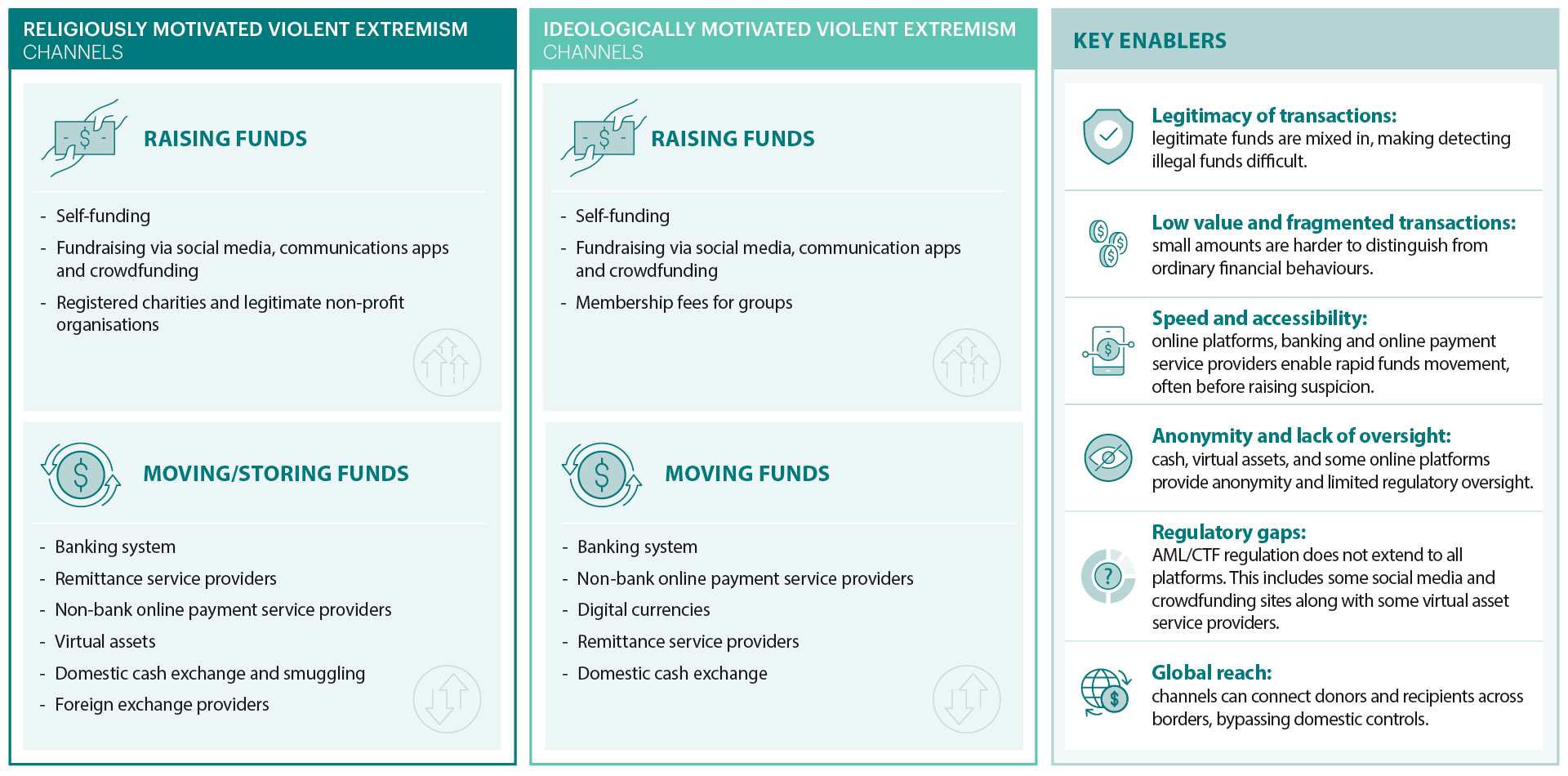
Core channels and threats identified in the Terrorism financing national risk assessment 2024 (NRA) remain the same. Domestic TF continues to be characterised by low value, adaptive activity, often with cross-border activity.
Domestic terrorism financing environment
Based on our insights and those from partner agencies and industry, Australia’s TF environment remains stable since the NRA was published in 2024. Domestic TF is small in scale and usually involves small amounts. Australia remains primarily an exporter of TF funds to offshore terrorist organisations and affiliated groups.
Where TF is identified it often involves basic support, such as the provision of items or small sums of money. In some cases, individuals may raise funds domestically to support violent extremists, including for purposes such as legal expenses or other lawful costs. These activities aren’t, in themselves, unlawful.
Individual’s funding terrorism
In other cases, individuals knowingly transfer funds directly to violent extremist groups or actors, including in connection with overseas conflicts or events. Elevated geopolitical tensions overseas can generate strong responses by individuals. This includes the provision of funds for legitimate humanitarian or charitable causes that are later diverted to support terrorism.
While the Australian non-profit organisation (NPO) sector overall presents a limited risk of terrorism financing, the potential consequences of any misuse remain substantial. Assessing risk in the sector is complicated by distributed regulatory oversight and limited visibility of the final beneficiary and use of funds once offshore. Additionally, many legitimate operational activities of NPOs may resemble risk indicators for TF abuse. This underscores the importance of not stigmatising these organisations as they carry out their essential roles.
Challenging environments and radicalisation
Partner agencies and industry partners highlighted a range of ongoing challenges in countering TF.
A persistently challenging environment
Challenges in countering TF aren’t unique to Australia and they:
- reduce traditional detection signals
- create persistent uncertainty around attribution and end‑use
- are amplified when funds move across borders or through opaque payment pathways.
Examples include:
- Obfuscation and disguising of activity
- TF is characterised by deliberate efforts to disguise and obscure its true purpose.
- Goods and transactions linked to TF are commonly hidden within otherwise lawful, non‑sanctioned activity to avoid scrutiny, including the purchase of everyday items or services that don’t immediately attract attention.
- Low value ‘high noise’ transaction signals
- Defining feature of TF in Australia is its low value, low‑volume presentation.
- Transactions are typically small and fragmented. This makes them often hard to distinguish from normal consumer behaviour within large financial datasets without supporting information or intelligence, or after an attack has occurred.
- Cross-border physical cash movements
- The physical movement of cash across international borders remains a persistent vulnerability.
- Identifying and stopping cash being carried offshore continues to pose challenges, particularly in flows associated with RMVE activity.
- Opaque digital and payment channels
- The growing use of cryptocurrency and non‑bank virtual asset service and payment providers has introduced greater levels of opacity and reduced transparency into the TF landscape.
- These channels can reduce end‑to‑end transparency through identity shielding, intermediary layering and cross‑jurisdictional settlement processes.
- While regulated entities provide some points of detection, uncertainty around the ultimate destination and use of funds, particularly when sent offshore via cryptocurrency, remains a persistent challenge.
- Speed of transactions
- Faster transactions through Australia’s real-time payment system make it harder to identify and freeze suspicious transfers.
- Faster payments reduce response windows and increase the risk of missed intervention.
- AI is further accelerating transaction speeds and complexity.
Radicalisation of young people
Young people can pose the same credible threat as adults in the terrorism landscape. They may be particularly vulnerable to radicalisation and recruitment by violent extremist groups. As ‘digital natives’, they often use online platforms and smartphones with ease. This can increase their exposure to violent extremist content and make activity harder to trace. It can also give young people and minors easier access to violent extremist content in a way that’s difficult to trace.
Young people often have a smaller financial footprint which reduces their interaction with financial institutions, making some indicators of TF more difficult to detect.
Uncertainty and unpredictability in domestic terrorism financing
While the domestic TF environment remains largely stable, with no significant changes since 2024, uncertainty and unpredictability in the domestic TF environment are rising.
Attack methods that generate little to no warning and have minimal or no clear financial indicators, challenge traditional detection approaches. Challenges include:
- Low-value self-funding meaning there are fewer clear financial signals.
- Rapid payment mechanisms reducing response timeframes.
Together, these factors increase uncertainty about when individuals develop intent, build capability and ultimately act. This rising uncertainty is unlikely to decrease in the near term.