
Our annual proliferation financing update details what channels and threats are influencing Australia’s proliferation financing environment.
On this page
- Focus of this update
- Exploiting financing institutions and emerging technologies
- Artificial intelligence and the use of virtual assets in proliferation financing
This proliferation financing (PF) annual update provides a snapshot of Australia’s PF environment and the broader factors that influence it. The PF methodologies identified in the Proliferation financing national risk assessment 2022 (NRA) remain relevant.
However, new challenges continue to emerge in PF nationally and internationally. The most significant challenges relate to the adoption and exploitation of artificial intelligence (AI) and virtual assets. Both are used to enhance established methodologies and as standalone PF methodologies.
Focus of this update
This update focuses on PF predominantly linked to the Democratic People’s Republic of Korea (DPRK) and Iran. Since the 2026 outbreak of hostilities in the Middle East, PF linked to Iran has become highly dynamic. This update provides a point-in-time analysis for the period before hostilities began.
This update adopts a broad approach to PF risk. It goes beyond the requirements under the Financial Action Task Force (FATF) to assess:
- targeted financial sanctions (TFS) obligations relating to the DPRK and Iran
- Australia’s exposure to a wide range of direct and indirect PF threats.
To be in scope, threats must have a connection to Australia, or threaten Australia’s:
- financial system
- key industries and technologies
- national security.
Learn more about Australia’s PF and sanctions framework.
Exploiting financing institutions and emerging technologies
PF remains a complex and evolving risk. The DPRK and Iran use a range of established and emerging methodologies to fund weapons of mass destruction programs. These include:
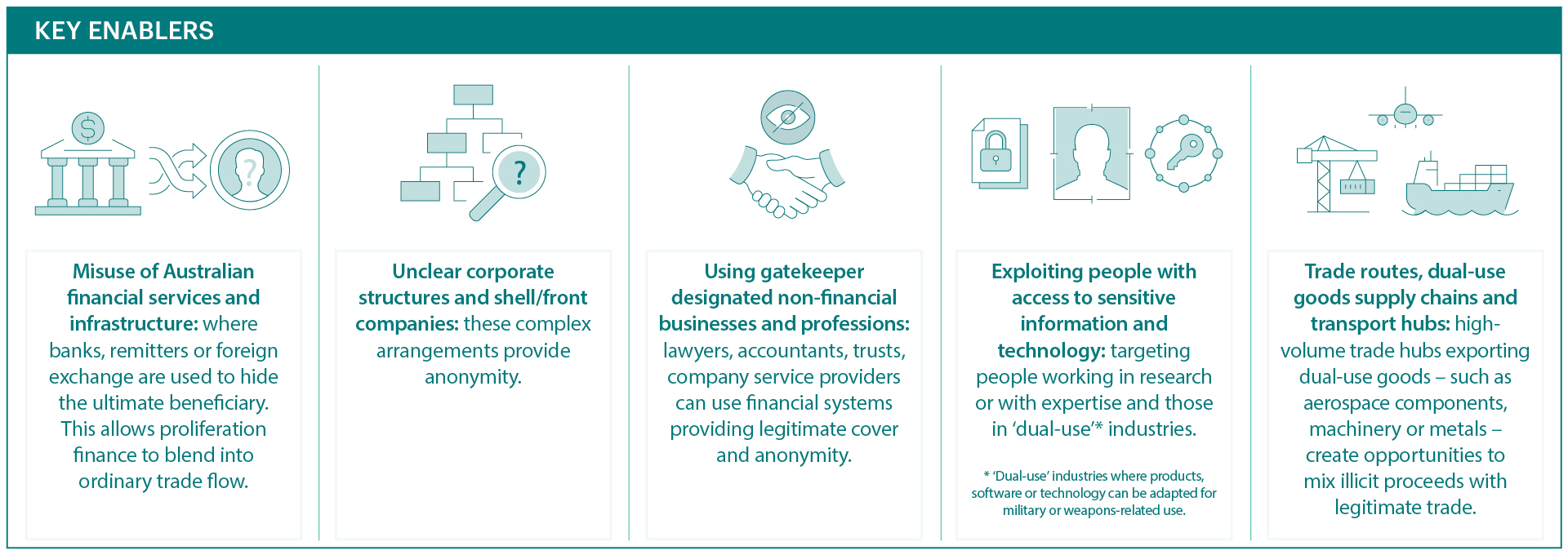
- front and shell companies
- opaque corporate and ownership structures
- trade-based money laundering.
They also exploit financial institutions and emerging technologies. This activity is typically designed to hide the ultimate beneficiary and the source and destination of funds. It’s also designed to hide the end-use and ultimate user of goods.
Australia’s proliferation financing risk
Australia’s open, rules-based system may be unknowingly exploited to conceal PF activity, often without the knowledge of legitimate businesses. PF risks cut across all sectors. This includes the procurement of dual-use goods (these are goods that have both civil and military applications) and the exploitation of industries.
In Australia, PF risk is shaped by exposure to foreign nationals, entities and transactions linked to jurisdictions of proliferation or diversion concern. Risk is higher where weak export controls in transhipment countries or enforcement gaps can be exploited.
Artificial intelligence and the use of virtual assets
PF faces several challenges going forward.
Embracing artificial intelligence
Artificial intelligence (AI) is likely to become an accelerant for PF actors. It enables them to scale, fast-track and further hide PF activity. AI can be used to:
- automate the creation and management of complex shell and front‑company networks
- generate fictitious entities
- generate convincing falsified trade, shipping and corporate documentation
- optimise sanctions contravention and export‑control evasion across multiple jurisdictions.
These capabilities enable PF actors to design sophisticated logistics chains and financial flows that hide the origin, movement and end‑use of funds and goods, often blending into legitimate trade and financial activity. As a result, PF activity is likely to become faster, more complex and increasingly difficult to detect. This heightens the risk that Australia’s open, trade‑integrated financial, corporate and logistics systems are unknowingly exploited by global PF networks.
Use of virtual assets
Virtual assets are increasingly used by some PF networks as a means of value‑transfer embedded within otherwise legitimate trade, financial and corporate activity, rather than as a standalone financing mechanism.
Blended into routine activities
PF actors often rely on lawful companies, professional services, logistics providers and international supply chains to procure goods, move revenue and facilitate trade. They use virtual assets selectively to move or store value at specific points within these pathways. For example, virtual assets may be used to settle obligations between overseas counterparties, hold value temporarily during trade transactions, or bridge payments across jurisdictions, while the underlying goods, services and corporate arrangements remain lawful and commercially plausible.
This integration allows PF-related value to blend into routine commercial activity. It aligns closely with the vulnerabilities identified in the NRA as key enablers of PF activity. For PF sanctioned states such as Iran, virtual assets have proven to be an alternative way to transfer value at scale when access to conventional financial systems is constrained.
Australia’s open and trade-integrated economy increases exposure to this risk. Proliferation finance-related financial flows may intersect with legitimate Australian importers, exporters, financial institutions and trade-connected service providers.
Use of stablecoins
This dynamic is reinforced by the growing use of stablecoins. Stablecoins are a type of cryptocurrency designed to maintain a relatively stable value by being pegged to an external asset, such as the US dollar. They can offer greater liquidity and price stability than more volatile cryptocurrencies. These features make stablecoins well-suited to use within trade-like financial activity. This increases the likelihood that Australia’s financial system and trade-connected industries are exploited by PF actors.
Democratic People’s Republic of Korea and virtual assets
The DPRK-linked actors stole more than $US2 billion in cryptocurrency in 2025 from Bybit, one of the world’s largest cryptocurrency exchanges. This is the largest known instance of state-linked crypto revenue generation globally.
We and our international partners have assessed that state-linked revenue generation cannot be meaningfully separated from the DPRK’s military and weapons of mass destruction (WMD) programs. As a result, funds generated by DPRK-linked actors present an inherently elevated PF risk, regardless of the method of acquisition.
Virtual assets facilitated the rapid conversion of funds into usable assets. This contributed to the circumvention of international sanctions and the funding of WMD development. The Royal United Services Institute (RUSI) also reported that DPRK groups accounted for roughly half of the nearly $4 billion stolen across the virtual asset ecosystem in 2022. Illicit proceeds from these operations funded the DPRK’s ballistic missile program.